Crocco relation
Assumptions
- \(\Pr = \frac{\mu c_p}{k} = 1\)
- adiabatic wall \(\frac{\partial T}{\partial y} = 0\)
- zero pressure gradient: \(\beta = 0\), therefore \(m = 0\) and \(u_e\) is constant
Relation
Derivation
Step 1: Start from the 2D compressible boundary layer energy equation
The 2D compressible boundary layer equations give the energy equation:
Step 2: Eliminate the pressure term
Define \(H = c_p T + u^2/2\). The pressure term \(u\,dp/dx\) in the energy equation has no counterpart in a clean transport form, so we eliminate it by adding the \(x\)-momentum equation multiplied by \(u\):
Multiply the \(x\)-momentum equation by \(u\):
Add this to the energy equation:
The pressure terms cancel exactly. The left-hand side is simply \(\rho(u\,\partial H/\partial x + v\,\partial H/\partial y)\).
For the right-hand side, the product rule gives:
After cancellation the equation reads:
Step 3: Require Pr = 1
With \(\Pr = 1\), thermal conductivity satisfies \(k = \mu c_p\). The two remaining terms on the right combine into a single flux of \(H\):
The result is a source-free transport equation for \(H\):
Because the right-hand side contains no forcing term, a spatially uniform \(H\) is always a valid solution, provided the boundary conditions allow it.
Step 4: Apply the boundary conditions
The wall-normal derivative of \(H\) is:
At the wall both terms vanish independently:
- No-slip: \(u_w = 0\), so \(u_w\,\partial u/\partial y|_w = 0\) regardless of the velocity gradient.
- Adiabatic: \(\partial T/\partial y|_w = 0\) (zero heat flux by definition).
Therefore \(\partial H/\partial y|_w = 0\), a homogeneous Neumann condition. At the boundary-layer edge, \(H = H_e = c_p T_e + u_e^2/2\) (Dirichlet).
Step 5: Identify the exact solution
The \(H\)-equation has no source term, and the zero-pressure-gradient case has a constant edge state. Since \(m = 0\), \(u_e\) is constant, so \(H_e = c_p T_e + u_e^2/2\) is constant as well. If \(H\) is constant, all derivatives of \(H\) vanish, so the transport equation is satisfied. The edge condition fixes that constant:
Substituting the definitions of \(H\) and \(H_e\) gives total enthalpy conservation across the boundary layer:
This is the key result: the total enthalpy is the edge total enthalpy at every \(\eta\).
Step 6: Non-dimensionalise
Divide by \(c_p T_e\), use \(u_e^2/(2 c_p T_e) = (\gamma - 1)M_e^2/2\), and identify \(T/T_e = \tau\) and \(u/u_e = f'\):
Therefore:
This is the Crocco relation used in the verification. It requires \(\Pr = 1\) and the zero-pressure-gradient case tested here.
Results
This holds for any \(M_e\) when \(\beta = 0\). Two cases are tested:
| Case | \(M_e\) | \(m\) | \(\beta\) |
|---|---|---|---|
| A | 1.5 | 0 | 0.0 |
| B | 3.0 | 0 | 0.0 |
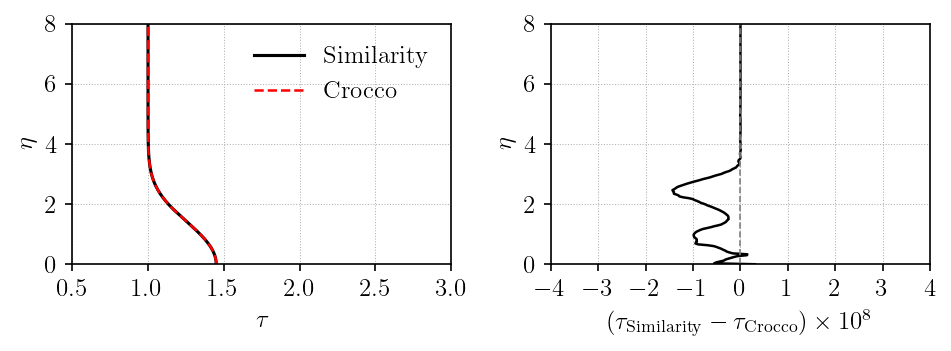
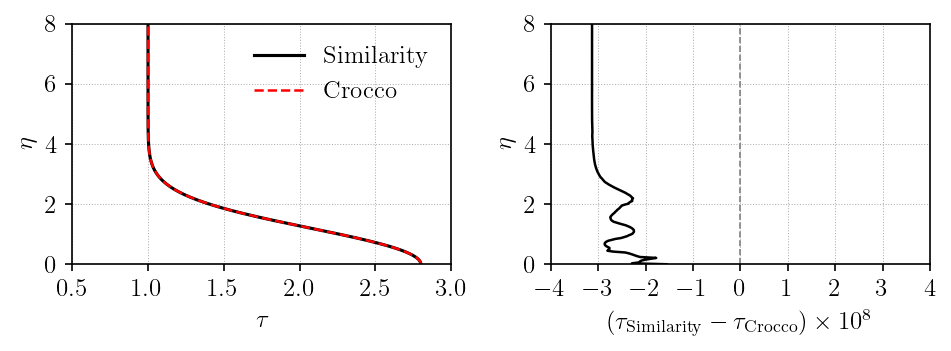
The similarity solution and Crocco relation agree well for both Mach numbers.
Run
The verification script is
vnv/verification/falkner_skan/crocco/verification_crocco.py.